


GetResponse to Airtable, subscribers logged clean
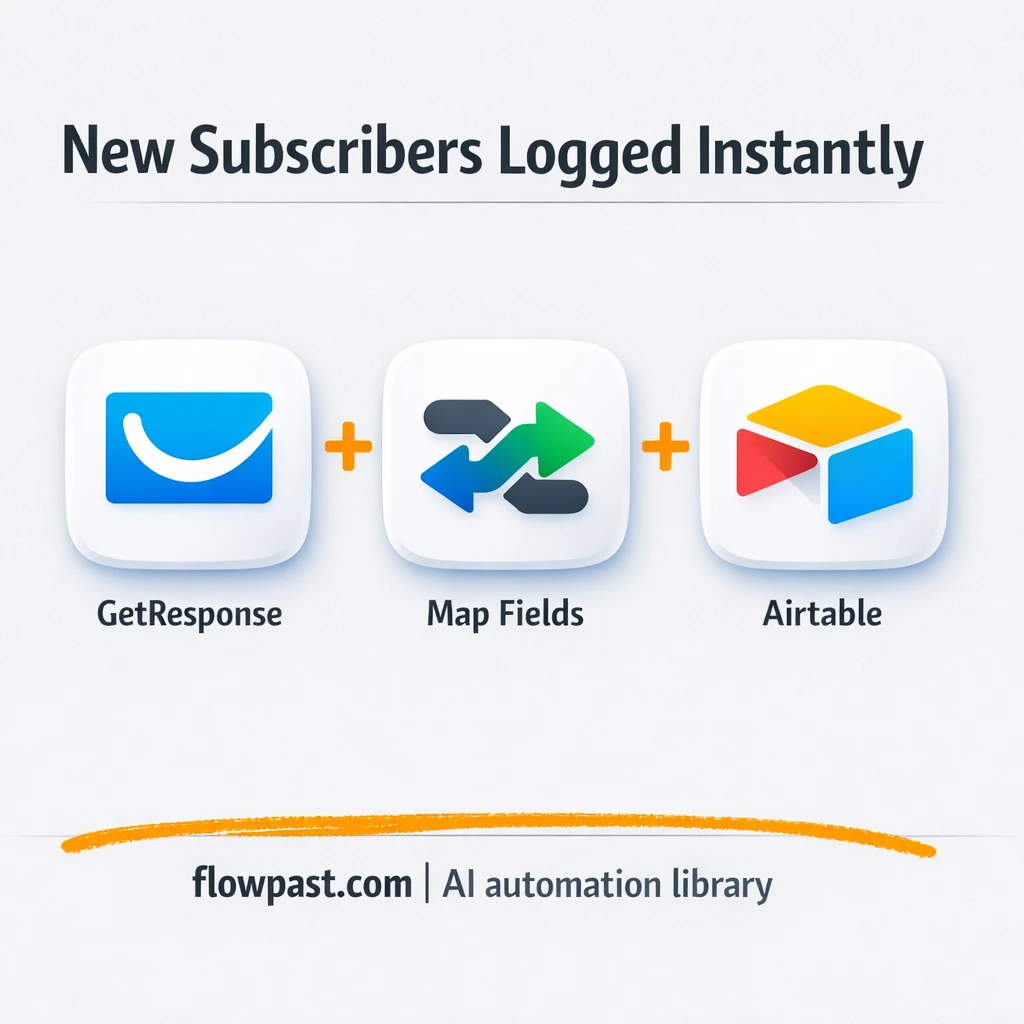

You get a new subscriber in GetResponse. Great. Then the messy part starts: exporting lists, copying emails into a spreadsheet, trying not to duplicate people, and realizing you still didn’t capture the name correctly.
Marketing managers feel it when follow-up slows down. A busy agency owner sees it when leads slip between clients. And founders doing their own marketing? They just want a GetResponse Airtable sync that keeps everything tidy without another weekly admin ritual.
This workflow watches for new GetResponse subscribers, maps the fields you actually care about, and logs them into Airtable automatically. You’ll see what it does, what you need, and how to make it fit your lead process.
How This Automation Works
The full n8n workflow, from trigger to final output:
n8n Workflow Template: GetResponse to Airtable, subscribers logged clean
flowchart LR

    subgraph sg0["GetResponse Flow"]
        direction LR
        n0["<div style='background:#f5f5f5;padding:10px;border-radius:8px;display:inline-block;border:1px solid #e0e0e0'><img src='https://flowpast.com/wp-content/uploads/n8n-workflow-icons/airtable.svg' width='40' height='40' /></div><br/>Airtable"]
        n1@{ icon: "mdi:swap-vertical", form: "rounded", label: "Set", pos: "b", h: 48 }
        n2["<div style='background:#f5f5f5;padding:10px;border-radius:8px;display:inline-block;border:1px solid #e0e0e0'><img src='https://flowpast.com/wp-content/uploads/n8n-workflow-icons/getResponse.png' width='40' height='40' /></div><br/>GetResponse Trigger"]
        n1 --> n0
        n2 --> n1
    end

    %% Styling
    classDef trigger fill:#e8f5e9,stroke:#388e3c,stroke-width:2px
    classDef ai fill:#e3f2fd,stroke:#1976d2,stroke-width:2px
    classDef aiModel fill:#e8eaf6,stroke:#3f51b5,stroke-width:2px
    classDef decision fill:#fff8e1,stroke:#f9a825,stroke-width:2px
    classDef database fill:#fce4ec,stroke:#c2185b,stroke-width:2px
    classDef api fill:#fff3e0,stroke:#e65100,stroke-width:2px
    classDef code fill:#f3e5f5,stroke:#7b1fa2,stroke-width:2px
    classDef disabled stroke-dasharray: 5 5,opacity: 0.5
    class n2 trigger
    class n0 database
    classDef customIcon fill:none,stroke:none
    class n0,n2 customIcon
The Problem: New subscribers fall into a tracking gap
GetResponse is fine at collecting subscribers. The problem is what happens right after. Most teams still need that new lead inside a shared system, usually Airtable, so they can segment, assign, and follow up. Without automation, you end up doing “little” admin tasks all week: exporting a CSV, filtering out duplicates, pasting emails into a table, and hoping nobody else changed the schema. It’s not hard work. It’s annoying work, and it always shows up at the worst time (like right before a campaign send).
It adds up fast. Here’s where it breaks down in real life.
- A single missed export can leave you following up days late, when the intent is already cold.
- Copy-paste data entry creates duplicates, typos, and blank “Name” fields that ruin personalization.
- If Airtable is your shared lead hub, manual updates mean the team never trusts what they’re looking at.
- Every new list, form, or lead magnet adds another place your process can silently fail.
The Solution: Auto-log GetResponse subscribers into Airtable
This n8n workflow turns GetResponse signups into clean, searchable Airtable records. It starts the moment someone subscribes to a specific list in GetResponse. n8n pulls the subscriber details from the event payload, then uses a simple “map fields” step to control what moves forward (so you don’t flood Airtable with noisy or inconsistent properties). Finally, it appends a new record to your chosen Airtable base and table with the exact fields you want, like name and email. Set it up once, and new subscribers show up where your team actually works.
The workflow begins with a GetResponse trigger when a contact is added. Then it standardizes the contact fields (name and email) using a Set step. Airtable receives that cleaned data and stores it as a new row, ready for sorting, views, and follow-up.
What You Get: Automation vs. Results
| What This Workflow Automates | Results You’ll Get |
|---|---|
|
|
Example: What This Looks Like
Say you average 15 new subscribers a day from ads and lead magnets. If logging each one takes “only” 2 minutes between export, search, paste, and cleanup, that’s about 30 minutes daily, or roughly 3 hours a week. With this workflow, the “work” is basically zero: the trigger fires instantly, mapping takes seconds, and Airtable updates automatically. You get those hours back, and you stop discovering gaps days later.
What You’ll Need
- n8n instance (try n8n Cloud free)
- Self-hosting option if you prefer (Hostinger works well)
- GetResponse for the subscriber list trigger.
- Airtable to store leads in a base/table.
- Airtable API token (get it from your Airtable account settings).
Skill level: Beginner. You’ll connect two accounts, pick your list and table, and confirm the fields match.
Don’t want to set this up yourself? Talk to an automation expert (free 15-minute consultation).
How It Works
A subscriber joins your GetResponse list. The workflow listens for the “customer added to list” event, so it reacts the moment the signup happens.
Contact data is cleaned and simplified. The field-mapping step passes only what you choose (in this case, name and email), which keeps Airtable predictable and easy to use.
Airtable gets a new record. n8n appends the subscriber to your chosen base and table, so your lead hub stays current without exports.
Your team works from one source of truth. Once the record exists, you can use Airtable views for segmentation, outreach lists, follow-up queues, or handoffs to another system.
You can easily modify the fields you capture to include things like list name, signup source, or tags based on your needs. See the full implementation guide below for customization options.
Step-by-Step Implementation Guide
Step 1: Configure the GetResponse Trigger
Set up the workflow to start whenever a new subscriber joins your GetResponse list.
- Add and open GetResponse Signup Trigger.
- Credential Required: Connect your getResponseApi credentials.
- Set Events to
subscribe. - Set List IDs to
[YOUR_ID](replace with your actual list ID).
[YOUR_ID] unchanged will prevent the trigger from firing. Replace it with a valid GetResponse list ID.Step 2: Set Up the Field Mapping
Normalize incoming contact data so Airtable receives consistent field names.
- Add and open Map Contact Fields.
- Enable Keep Only Set to
true. - Add a string field Name with value
={{$json["contact_name"]}}. - Add a string field Email with value
={{$json["contact_email"]}}.
Step 3: Connect Airtable
Configure Airtable to store each new subscriber record.
- Add and open Append Airtable Entry.
- Credential Required: Connect your airtableApi credentials.
- Set Operation to
append. - Set Table to
Table 1. - Choose the correct Application (Base) for your subscriber table.
Step 4: Confirm the Execution Flow
Ensure the nodes are connected in the correct order to process and store subscriber data.
- Connect GetResponse Signup Trigger to Map Contact Fields.
- Connect Map Contact Fields to Append Airtable Entry.
Step 5: Test and Activate Your Workflow
Run a manual test to verify that new subscribers are correctly mapped and stored in Airtable.
- Use GetResponse Signup Trigger to send a test subscription event from your list.
- Confirm that Map Contact Fields outputs the expected Name and Email values.
- Verify a new record appears in Airtable via Append Airtable Entry.
- Click Activate to enable the workflow for production use.
Common Gotchas
- Airtable credentials can expire or need specific permissions. If things break, check your Airtable token access and base permissions first.
- If you later add batching (Split in Batches) or delays, processing times vary. Bump up the wait duration if downstream steps fail because data hasn’t arrived yet.
- Field mapping defaults can be too minimal for real follow-up. Add source fields (like campaign or list name) early, or you will be cleaning and enriching leads forever.
Frequently Asked Questions
About 20 minutes if your GetResponse list and Airtable table already exist.
No. You’ll just connect GetResponse and Airtable, then map fields like name and email.
Yes. n8n has a free self-hosted option and a free trial on n8n Cloud. Cloud plans start at $20/month for higher volume. You’ll also need to factor in Airtable plan limits if your base grows quickly.
Two options: n8n Cloud (managed, easiest setup) or self-hosting on a VPS. For self-hosting, Hostinger VPS is affordable and handles n8n well. Self-hosting gives you unlimited executions but requires basic server management.
Yes, but you’ll want a small tweak. You can duplicate the GetResponse Signup Trigger for each list, then reuse the same Map Contact Fields step, and route everything into one Airtable table (or separate tables) based on your reporting needs. A common setup is one base, one table, plus a “List” field so you can filter views per lead magnet.
Most of the time it’s an expired token or the wrong GetResponse account connected. Reconnect the GetResponse credentials in n8n, then confirm the trigger is watching the correct list. If it still doesn’t fire, check if the subscriber is being added through a method that doesn’t trigger events (some imports behave differently), and run a quick test signup to confirm.
A lot. On n8n Cloud Starter plan, you can typically handle thousands of trigger events per month for a simple workflow like this, and higher plans go further. If you self-host, there’s no execution cap (it depends on your server). Airtable becomes the main constraint, so watch record limits and API rate limits if you’re doing big spikes from ads.
Often, yes. n8n is more flexible when you need branching logic, extra validation, or additional steps later (like checking duplicates, merging fields, or notifying a team chat). Self-hosting is also a big deal if you don’t want to pay more as volume grows. Zapier or Make can still be fine for a simple “trigger → create record” flow, especially if you never plan to expand it. If you’re unsure, Talk to an automation expert and get a straight recommendation for your setup.
Once GetResponse and Airtable stay in sync, lead tracking stops being a weekly chore. The workflow handles the repetitive stuff so you can focus on follow-up that actually moves revenue.
Need Help Setting This Up?
Our automation experts can build and customize this workflow for your specific needs. Free 15-minute consultation—no commitment required.
