


LinkedIn to Google Sheets, job leads logged clean
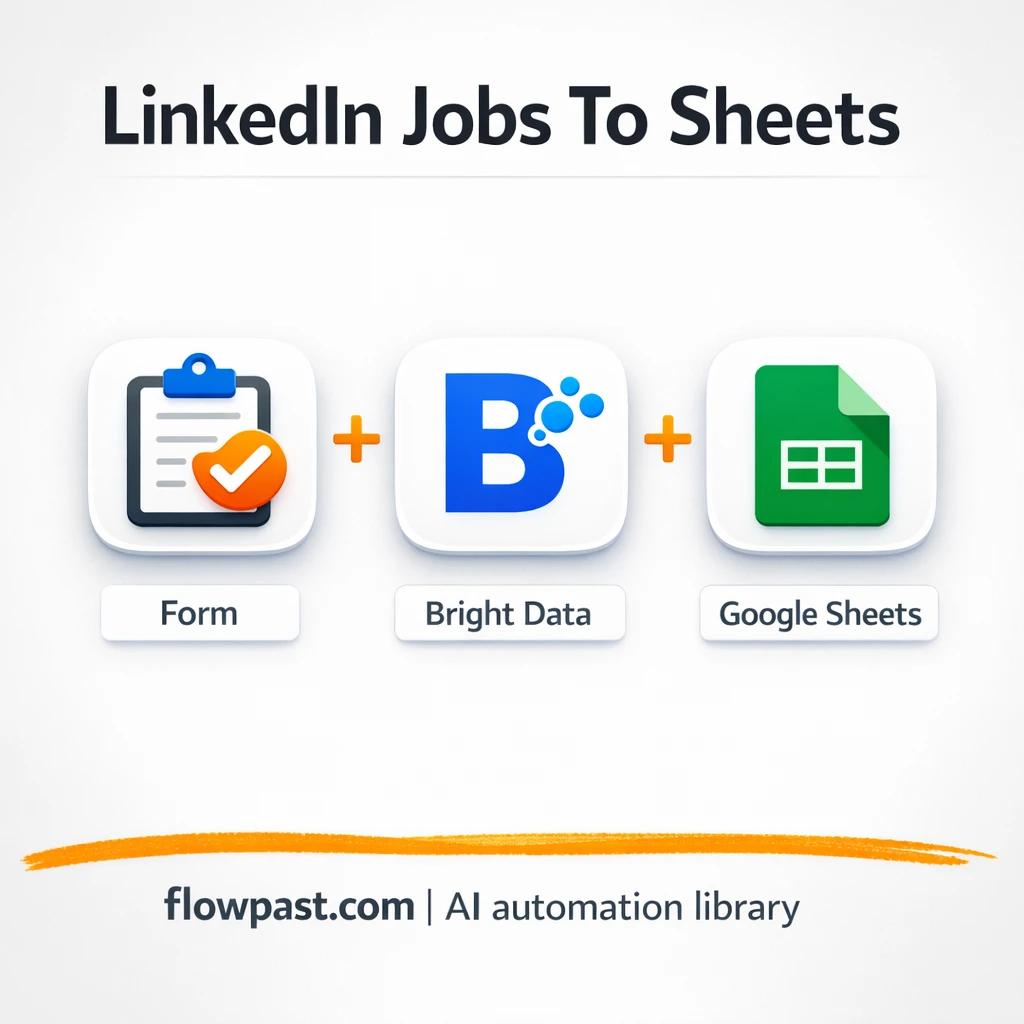

Copying job posts out of LinkedIn is the kind of “quick task” that quietly steals your week. Tabs multiply, links get lost, and the one job you meant to apply for disappears under a pile of screenshots.
Recruiters feel it when sourcing spikes. Job seekers hit it during a serious search sprint. And HR ops teams see the same mess when they’re tracking competitor hiring. This LinkedIn Sheets automation turns job hunting into a clean, searchable spreadsheet you can actually use.
Below, you’ll see how the workflow pulls listings with Bright Data, waits for the dataset to be ready, filters the results, and logs everything into Google Sheets with consistent fields and reliable apply links.
How This Automation Works
See how this solves the problem:
n8n Workflow Template: LinkedIn to Google Sheets, job leads logged clean
flowchart LR

    subgraph sg0["On form submission1 Flow"]
        direction LR
        n0["<div style='background:#f5f5f5;padding:10px;border-radius:8px;display:inline-block;border:1px solid #e0e0e0'><img src='https://flowpast.com/wp-content/uploads/n8n-workflow-icons/form.svg' width='40' height='40' /></div><br/>On form submission1"]
        n1@{ icon: "mdi:swap-horizontal", form: "rounded", label: "Check Final Status", pos: "b", h: 48 }
        n2["<div style='background:#f5f5f5;padding:10px;border-radius:8px;display:inline-block;border:1px solid #e0e0e0'><img src='https://flowpast.com/wp-content/uploads/n8n-workflow-icons/httprequest.dark.svg' width='40' height='40' /></div><br/>Create Snapshot ID"]
        n3["<div style='background:#f5f5f5;padding:10px;border-radius:8px;display:inline-block;border:1px solid #e0e0e0'><img src='https://flowpast.com/wp-content/uploads/n8n-workflow-icons/httprequest.dark.svg' width='40' height='40' /></div><br/>Check Snapshot Status"]
        n4@{ icon: "mdi:cog", form: "rounded", label: "Wait 1 minute", pos: "b", h: 48 }
        n5["<div style='background:#f5f5f5;padding:10px;border-radius:8px;display:inline-block;border:1px solid #e0e0e0'><img src='https://flowpast.com/wp-content/uploads/n8n-workflow-icons/httprequest.dark.svg' width='40' height='40' /></div><br/>Scrape Data from SnapID"]
        n6@{ icon: "mdi:database", form: "rounded", label: "Update Job Lists in sheet", pos: "b", h: 48 }
        n7@{ icon: "mdi:swap-horizontal", form: "rounded", label: "Filter", pos: "b", h: 48 }
        n8@{ icon: "mdi:swap-horizontal", form: "rounded", label: "If", pos: "b", h: 48 }
        n8 --> n5
        n7 --> n6
        n4 --> n3
        n1 --> n8
        n1 --> n4
        n2 --> n3
        n0 --> n2
        n3 --> n1
        n5 --> n7
    end

    %% Styling
    classDef trigger fill:#e8f5e9,stroke:#388e3c,stroke-width:2px
    classDef ai fill:#e3f2fd,stroke:#1976d2,stroke-width:2px
    classDef aiModel fill:#e8eaf6,stroke:#3f51b5,stroke-width:2px
    classDef decision fill:#fff8e1,stroke:#f9a825,stroke-width:2px
    classDef database fill:#fce4ec,stroke:#c2185b,stroke-width:2px
    classDef api fill:#fff3e0,stroke:#e65100,stroke-width:2px
    classDef code fill:#f3e5f5,stroke:#7b1fa2,stroke-width:2px
    classDef disabled stroke-dasharray: 5 5,opacity: 0.5
    class n0 trigger
    class n1,n7,n8 decision
    class n6 database
    class n2,n3,n5 api
    classDef customIcon fill:none,stroke:none
    class n0,n2,n3,n5 customIcon
The Challenge: LinkedIn job leads that get messy fast
LinkedIn is great for discovery. It’s not great for tracking. You find a promising role, open it in a new tab, and tell yourself you’ll come back later. Then the day happens. When you do return, you can’t remember why you saved it, the apply link sends you to a generic company page, and the details you cared about (location, job type, posted date, that one keyword) are scattered across notes, bookmarks, and half-finished spreadsheets. Honestly, it’s exhausting when you’re trying to be consistent.
It adds up fast. Here’s where it breaks down in real life.
- Manual copy-paste turns into a daily chore, and you still end up with missing fields like company URL or a clean apply link.
- Job titles and locations land in different formats, which makes filtering and sorting in Google Sheets frustrating.
- You don’t know what you’ve already reviewed, so you re-open the same postings and waste another 20 minutes.
- When someone else needs the list (a manager, a client, a partner), sharing becomes a scramble instead of a simple sheet link.
The Fix: Bright Data pulls LinkedIn jobs and Sheets logs them
This workflow replaces the messy “hunt and copy” loop with a simple intake form and a repeatable data pipeline. You submit your search criteria (city, job title, country, and optionally job type). n8n sends that request to Bright Data’s LinkedIn dataset, which returns a snapshot job feed in a structured format. While Bright Data prepares the snapshot, the workflow checks status, waits a bit, then checks again until the data is ready. Once the results are available, it downloads the snapshot, filters for the matches you care about, and appends clean rows into Google Sheets so your tracking stays consistent across searches.
The workflow starts with a form submission. From there, Bright Data does the heavy lifting to fetch LinkedIn job postings and return structured fields. Finally, Google Sheets becomes your “source of truth” for company details, locations, job summaries, and apply links.
What Changes: Before vs. After
| What This Eliminates | Impact You’ll See |
|---|---|
|
|
Real-World Impact
Say you run 10 LinkedIn searches a week (different cities or titles), and each one returns about 20 job listings. Manually logging those 200 roles at roughly 2 minutes each is about 6 hours of pure copying and cleanup. With this workflow, the “work” is the form submission (about 2 minutes per search), then you wait 30–60 seconds for processing while n8n fills the sheet. You get most of that time back, and the data is cleaner.
Requirements
- n8n instance (try n8n Cloud free)
- Self-hosting option if you prefer (Hostinger works well)
- Google Sheets for storing and sharing job leads.
- Bright Data to access the LinkedIn jobs dataset via API.
- Bright Data API token + dataset access (get it from your Bright Data dashboard).
Skill level: Beginner. You’ll mainly connect accounts, map a few columns, and adjust search filters.
Need help implementing this? Talk to an automation expert (free 15-minute consultation).
The Workflow Flow
Form submission triggers the search. You enter the job title, city, country, and optional job type in an n8n form, which keeps requests standardized.
Bright Data is asked to create a snapshot. n8n sends an HTTP request to Bright Data to start the LinkedIn dataset job, then checks the snapshot status until it’s ready.
Results are downloaded and filtered. Once Bright Data reports data is available, the workflow pulls the snapshot content, then filters out anything that doesn’t match your criteria.
Google Sheets gets updated automatically. Each matching job is appended as a new row with the fields you care about, so the sheet becomes a living job lead log.
You can easily modify the search limits and time range to match your pace. See the full implementation guide below for customization options.
Step-by-Step Implementation Guide
Step 1: Configure the Form Trigger
Set up the user intake form that starts the workflow and passes search parameters into the Bright Data request.
- Add and open Form Intake Trigger.
- Set Form Title to
LinkedIn Job Finder. - Under Form Fields, create fields with labels City, Job Title, and Country, all required.
- Add a dropdown field labeled Job_type(Optional) with options
Full-Time,Part-Time,Remote,WFH,Contract,Internship, andFreelance. - Connect Form Intake Trigger to Initiate Snapshot Request.
Step 2: Connect Google Sheets
Configure the sheet destination where matched jobs will be appended.
- Open Append Jobs to Sheet.
- Credential Required: Connect your
googleSheetsOAuth2Apicredentials. - Set Document to your spreadsheet (replace
[YOUR_ID]with your file). - Set Sheet Name to
Sheet1(gid0), or select your target sheet. - Keep Operation set to
append. - Map columns exactly as configured: Location →
={{ $json.job_location }}, Job Title →={{ $json.job_title }}, Apply Link →={{ $json.apply_link }}, Job Detail →={{ $json.job_summary }}, Company URL →={{ $json.company_url }}, Company Name →={{ $json.company_name }}.
Step 3: Set Up the Snapshot Request and Status Loop
Trigger the Bright Data dataset, then repeatedly check the snapshot status until it is ready.
- Open Initiate Snapshot Request and set URL to
https://api.brightdata.com/datasets/v3/triggerand Method toPOST. - In Query Parameters, set dataset_id to
[YOUR_ID], include_errors totrue, type todiscover_new, discover_by tokeyword, and limit_per_input to2. - In Header Parameters, set Authorization to
Bearer [CONFIGURE_YOUR_TOKEN]. - Set JSON Body to the provided expression starting with
={, ensuring the fields forlocation,keyword,country, andjob_typereference Form Intake Trigger as shown. - Open Retrieve Snapshot Status and set URL to
=https://api.brightdata.com/datasets/v3/progress/{{ $json.snapshot_id }}. - In Retrieve Snapshot Status, set Header Parameters → Authorization to
Bearer [CONFIGURE_YOUR_TOKEN]and add Query Parameters → format tojson. - Open Evaluate Ready State and set the condition to equals with Left Value
={{ $json.status }}and Right Valueready. - Ensure the execution flow is: Initiate Snapshot Request → Retrieve Snapshot Status → Evaluate Ready State.
- Confirm that Evaluate Ready State routes to Records Present Check when true and to Pause One Minute when false, and that Pause One Minute loops back to Retrieve Snapshot Status.
[YOUR_ID] and [CONFIGURE_YOUR_TOKEN] in the Bright Data requests, or the snapshot will never start.Step 4: Configure Data Retrieval, Filtering, and Output
Download the snapshot results, filter for relevant rows, and append them to Google Sheets.
- Open Records Present Check and verify the condition checks Left Value
={{ $json.records }}not equals={{ 0 }}. - Open Download Snapshot Data and set URL to
=https://api.brightdata.com/datasets/v3/snapshot/{{ $json.snapshot_id }}. - In Download Snapshot Data, set Header Parameters → Authorization to
Bearer [CONFIGURE_YOUR_TOKEN]and add Query Parameters → format tojson. - Open Filter Matched Results and set a contains condition with Left Value
={{ $json.job_summary }}and Right Value={{ $json.shortCommonName }}. - Ensure the flow is: Records Present Check → Download Snapshot Data → Filter Matched Results → Append Jobs to Sheet.
Step 5: Test and Activate Your Workflow
Run a full test to verify the dataset completes, filters properly, and appends rows into your spreadsheet.
- Click Execute Workflow and submit the form in Form Intake Trigger with a real job title and location.
- Verify that Initiate Snapshot Request returns a
snapshot_idand that Retrieve Snapshot Status eventually returnsready. - Confirm Download Snapshot Data returns records and that Filter Matched Results passes at least one item.
- Check the Google Sheet to confirm new rows are appended with Location, Job Title, and Apply Link values.
- Turn the workflow Active to enable continuous use.
Watch Out For
- Bright Data credentials can expire or need specific permissions. If things break, check your Bright Data dashboard (API token and dataset access) first.
- If you’re using Wait nodes or external snapshot generation, processing times vary. Bump up the wait duration if downstream nodes fail on empty responses.
- Google Sheets permission errors are common after sharing changes. Re-authenticate the Google account in n8n and confirm the sheet is accessible to that account.
Common Questions
About 30 minutes if your Bright Data and Google accounts are ready.
Yes. No coding is required, but you will need to paste in an API token and map your Google Sheets columns once.
Yes. n8n has a free self-hosted option and a free trial on n8n Cloud. Cloud plans start at $20/month for higher volume. You’ll also need to factor in Bright Data dataset and API usage costs based on your plan.
Two options: n8n Cloud (managed, easiest setup) or self-hosting on a VPS. For self-hosting, Hostinger VPS is affordable and handles n8n well. Self-hosting gives you unlimited executions but requires basic server management.
You can tweak what “good results” mean by adjusting the Bright Data request (the snapshot creation request) and the filtering step that runs before Google Sheets is updated. Common customizations include changing the time range (like “past week” vs “past month”), increasing the result limit, and adding extra fields such as seniority or salary when your dataset supports it.
Usually it’s an invalid or expired API token. Update the token in the HTTP Request credentials, confirm your LinkedIn dataset access is enabled in Bright Data, and watch for rate limits if you’re running lots of searches back-to-back.
Bright Data is the real limiter here, but the workflow itself is built for batch-style processing and can comfortably handle dozens of searches a day on a typical plan.
Often, yes, because this workflow needs looping, waiting for snapshot readiness, and conditional checks that get awkward (and pricey) in simpler automation tools. n8n handles branching logic cleanly, and self-hosting can remove execution limits if you run a lot of searches. Zapier or Make can still work if you only run occasional searches and don’t care about status polling. The trade-off is control. Talk to an automation expert if you want help choosing the simplest setup for your volume.
Once this is running, your job lead tracking stops being a daily cleanup project. The workflow handles the repetitive collection, and your Google Sheet stays ready for review, sharing, and action.
Need Help Setting This Up?
Our automation experts can build and customize this workflow for your specific needs. Free 15-minute consultation—no commitment required.
