


Google Sheets to Google Drive, website proofs sorted
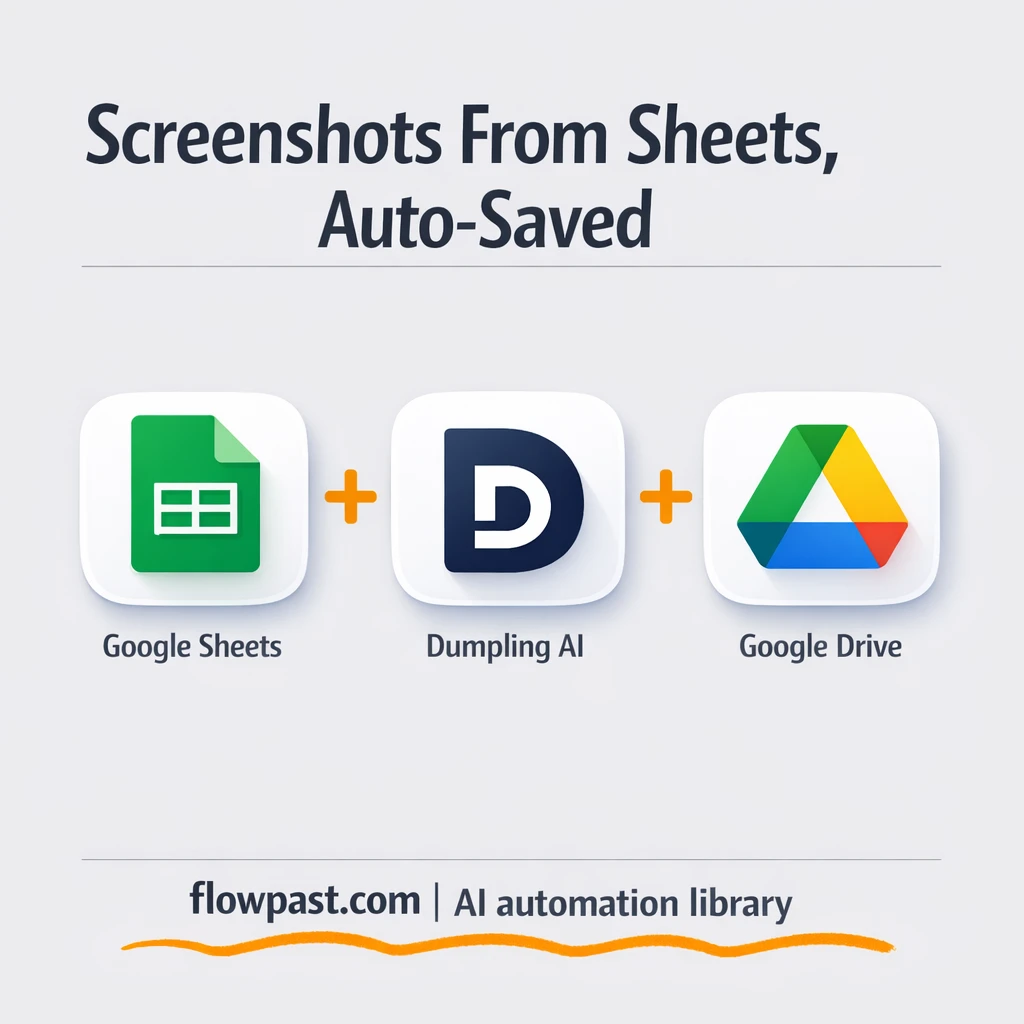

You add a URL to a sheet, then someone has to open the site, scroll, grab screenshots, name files, and upload them somewhere sensible. It’s tedious. And it’s the kind of “quick task” that quietly eats half your afternoon.
Marketing managers feel it when proof requests come in nonstop. A lead gen specialist trying to document landing pages feels it too. Even a small agency owner running client audits ends up stuck in the same loop. This website screenshot automation turns a plain Google Sheet into a hands-off proof machine.
Below, you’ll see how the n8n workflow captures a full-page screenshot for each new URL and drops the image into Google Drive, automatically and consistently.
How This Automation Works
The full n8n workflow, from trigger to final output:
n8n Workflow Template: Google Sheets to Google Drive, website proofs sorted
flowchart LR

    subgraph sg0["Monitor New Sheet Row Flow"]
        direction LR
        n0@{ icon: "mdi:play-circle", form: "rounded", label: "Monitor New Sheet Row", pos: "b", h: 48 }
        n1["<div style='background:#f5f5f5;padding:10px;border-radius:8px;display:inline-block;border:1px solid #e0e0e0'><img src='https://flowpast.com/wp-content/uploads/n8n-workflow-icons/httprequest.dark.svg' width='40' height='40' /></div><br/>Capture Screenshot via API"]
        n2["<div style='background:#f5f5f5;padding:10px;border-radius:8px;display:inline-block;border:1px solid #e0e0e0'><img src='https://flowpast.com/wp-content/uploads/n8n-workflow-icons/httprequest.dark.svg' width='40' height='40' /></div><br/>Retrieve Screenshot File"]
        n3@{ icon: "mdi:cog", form: "rounded", label: "Store Image in Drive", pos: "b", h: 48 }
        n2 --> n3
        n0 --> n1
        n1 --> n2
    end

    %% Styling
    classDef trigger fill:#e8f5e9,stroke:#388e3c,stroke-width:2px
    classDef ai fill:#e3f2fd,stroke:#1976d2,stroke-width:2px
    classDef aiModel fill:#e8eaf6,stroke:#3f51b5,stroke-width:2px
    classDef decision fill:#fff8e1,stroke:#f9a825,stroke-width:2px
    classDef database fill:#fce4ec,stroke:#c2185b,stroke-width:2px
    classDef api fill:#fff3e0,stroke:#e65100,stroke-width:2px
    classDef code fill:#f3e5f5,stroke:#7b1fa2,stroke-width:2px
    classDef disabled stroke-dasharray: 5 5,opacity: 0.5
    class n0 trigger
    class n1,n2 api
    classDef customIcon fill:none,stroke:none
    class n1,n2 customIcon
The Problem: Website proof collection is slow and inconsistent
Website screenshots sound simple until you have to do them at scale. You’re collecting proofs for a campaign, a redesign, a lead list, or a client report, and suddenly you’re juggling 20 tabs. Then comes the messy part: you capture the wrong fold, the page loads a cookie banner mid-shot, filenames become “screenshot-final-2-reallyfinal.png,” and nobody can find the right proof later. The worst part is the mental load. You can’t fully focus on analysis or outreach because you’re stuck doing busywork that never really ends.
One screenshot isn’t the problem. Ten per day is. Here’s where it breaks down.
- Manual screenshotting turns into about 10 minutes per URL once you include loading, scrolling, capturing, and uploading.
- File naming and folder hygiene depend on whoever did it, which means your “proof archive” quickly becomes a junk drawer.
- Teams miss changes because there’s no reliable cadence, so “before vs. after” proofs are incomplete when you need them most.
- Copy-paste errors happen, especially when you’re moving between Sheets, the browser, and Drive all day.
The Solution: Google Sheets → full-page screenshots → Google Drive
This n8n workflow watches your Google Sheet for new rows. When you add a URL in a column labeled “Website,” it sends that URL to Dumpling AI’s screenshot API to generate a full-page capture. Once Dumpling returns a screenshot link, the workflow downloads the image file automatically, then uploads it to a specific Google Drive folder you choose. No browser tab juggling. No manual file handling. Your Drive becomes a clean, dependable proof archive that updates itself as your sheet grows.
The flow starts in Google Sheets with a new row. Dumpling AI creates the screenshot and hands back a downloadable file URL. Then Google Drive stores the final image, ready to share with a client or drop into a report.
What You Get: Automation vs. Results
| What This Workflow Automates | Results You’ll Get |
|---|---|
|
|
Example: What This Looks Like
Say you collect 20 landing page proofs every week for outreach and competitor tracking. Manually, plan on roughly 10 minutes per URL once you include opening pages, scrolling, saving, naming, and uploading, which is about 3 hours weekly. With this workflow, you paste the 20 URLs into Google Sheets (maybe 10 minutes total), then the automation generates and uploads screenshots while you move on. You get your proof archive without babysitting it.
What You’ll Need
- n8n instance (try n8n Cloud free)
- Self-hosting option if you prefer (Hostinger works well)
- Google Sheets to store URLs in a “Website” column
- Google Drive to store the screenshot files
- Dumpling AI API key (get it from your Dumpling AI account dashboard)
Skill level: Beginner. You’ll connect accounts, paste IDs for your sheet and Drive folder, and run a quick test.
Don’t want to set this up yourself? Talk to an automation expert (free 15-minute consultation).
How It Works
A new website URL is added to Google Sheets. The workflow listens for new rows in your chosen sheet, using the “Website” column as the source of truth.
The URL is sent to Dumpling AI for a screenshot. n8n calls the screenshot API via HTTP request and receives a link to the generated full-page image.
The workflow fetches the actual image file. It downloads the screenshot from the returned URL so it can be handled like a normal file inside the workflow.
Google Drive stores the proof automatically. The file is uploaded into your selected Drive folder, which keeps your archive tidy and centralized.
You can easily modify the filename and folder structure to match client names, domains, or dates based on your needs. See the full implementation guide below for customization options.
Step-by-Step Implementation Guide
Step 1: Configure the Google Sheets Trigger
Set up the trigger that watches for new rows so each new website entry kicks off the screenshot capture flow.
- Add and configure Monitor New Sheet Row.
- Set Event to
rowAdded. - Set Sheet Name to
Sheet1. - Set Document to
Website List. - Keep the polling schedule at
everyMinutefor near-real-time monitoring. - Credential Required: Connect your googleSheetsTriggerOAuth2Api credentials.
Website column header because Capture Screenshot via API uses {{ $json.Website }}.Step 2: Connect Google Sheets
Confirm that your Google Sheets connection is fully authorized so the trigger can read new entries.
- Open Monitor New Sheet Row and click Connect Credential.
- Credential Required: Connect your googleSheetsTriggerOAuth2Api credentials.
- Verify the selected account can access the
Website Listspreadsheet.
Step 3: Set Up Screenshot Capture and Retrieval
Configure the API call that generates a screenshot and then fetch the resulting image file.
- Open Capture Screenshot via API and set URL to
https://app.dumplingai.com/api/v1/screenshot. - Set Method to
POSTand enable Send Body. - Set Body Content Type to
jsonand paste this into JSON Body:={ "url": "{{ $json.Website }}", "fullPage": true }. - Credential Required: Connect your httpHeaderAuth credentials for the Dumpling AI API.
- Open Retrieve Screenshot File and set URL to
={{ $json.screenshotUrl }}to fetch the generated image.
screenshotUrl, Retrieve Screenshot File will fail. Verify your Dumpling AI account and API limits.Step 4: Configure the Output to Google Drive
Store the retrieved screenshot file in your Google Drive folder for archiving.
- Open Store Image in Drive and set Name to
temp-488dda43-93de-4fa6-acfc-f3977c584ab1.png. - Set Drive to
My Drive. - Set Folder to the target folder ID (currently
[YOUR_ID]). - Credential Required: Connect your googleDriveOAuth2Api credentials.
[YOUR_ID] with a real folder ID; otherwise, the file upload will fail.Step 5: Test and Activate Your Workflow
Run a manual test to confirm the end-to-end flow, then activate the workflow for production use.
- Click Execute Workflow and add a new row in your
Website Listsheet with a valid URL in theWebsitecolumn. - Confirm the execution path follows Monitor New Sheet Row → Capture Screenshot via API → Retrieve Screenshot File → Store Image in Drive.
- Verify a new image appears in the specified Google Drive folder.
- Toggle the workflow to Active to start automated monitoring.
Common Gotchas
- Google Sheets credentials can expire or need specific permissions. If things break, check the n8n Credentials section and make sure the Google account still has access to the spreadsheet.
- Dumpling AI screenshot generation can take longer on heavy pages. If the download step fails, increase the delay between the screenshot request and the file retrieval so you’re not pulling an image that isn’t ready.
- Google Drive uploads may succeed but land in the wrong place if the folder ID is wrong or the account can’t see that folder. Open the folder in Drive and confirm the ID and sharing permissions match the connected Google account.
Frequently Asked Questions
About 30 minutes if your accounts are ready.
No. You’ll mainly connect Google and Dumpling AI, then paste in your Sheet and folder details.
Yes. n8n has a free self-hosted option and a free trial on n8n Cloud. Cloud plans start at $20/month for higher volume. You’ll also need to factor in Dumpling AI API usage costs based on how many screenshots you generate.
Two options: n8n Cloud (managed, easiest setup) or self-hosting on a VPS. For self-hosting, Hostinger VPS is affordable and handles n8n well. Self-hosting gives you unlimited executions but requires basic server management.
Yes, but you’ll want to do it intentionally. In n8n, add an Edit Fields (Set) step before the Google Drive upload to build a filename using the domain plus today’s date. Many teams also write the Google Drive file URL back into the same Google Sheet row for easy access. If you want a client-friendly archive, you can also route different domains into different Drive folders using a simple Switch.
Usually it’s an expired Google login or the connected account doesn’t have access to the target Drive folder. Reconnect Google Drive in n8n and confirm the folder is shared with that same account. Also double-check that the folder ID in the workflow matches the folder you think it does.
A lot, as long as your n8n plan and Dumpling AI limits match your volume. On n8n Cloud, your cap is mostly executions per month, while self-hosting depends on your server. Practically, most teams start with a few dozen screenshots per day and scale from there, then adjust wait time if pages are heavy.
For this use case, n8n is often a better fit because calling an API, downloading a binary file, and then uploading to Google Drive is the kind of multi-step flow that gets awkward (and expensive) in simpler tools. n8n also gives you more control over retries, branching, and data cleanup without turning everything into separate paid “tasks.” Zapier or Make can still work if you only run a handful of screenshots and want the simplest UI. If you’re unsure, Talk to an automation expert and pick the tool you won’t hate in three months.
Once this is running, your proof archive updates itself while you keep working. Honestly, it’s the kind of small automation that makes everything else feel less chaotic.
Need Help Setting This Up?
Our automation experts can build and customize this workflow for your specific needs. Free 15-minute consultation—no commitment required.
