


Google Sheets + Gmail: student check-ins logged fast

Attendance shouldn’t feel like detective work. But when check-ins come in through a QR app, a message, or a hallway clipboard, you end up retyping names, fixing typos, and wondering what you missed.
Teachers get interrupted mid-lesson, school admins end up chasing “Did they arrive?” answers, and after-school program leads deal with the same messy logs. This Google Sheets attendance automation puts every check-in into one clean sheet and pings the right person immediately.
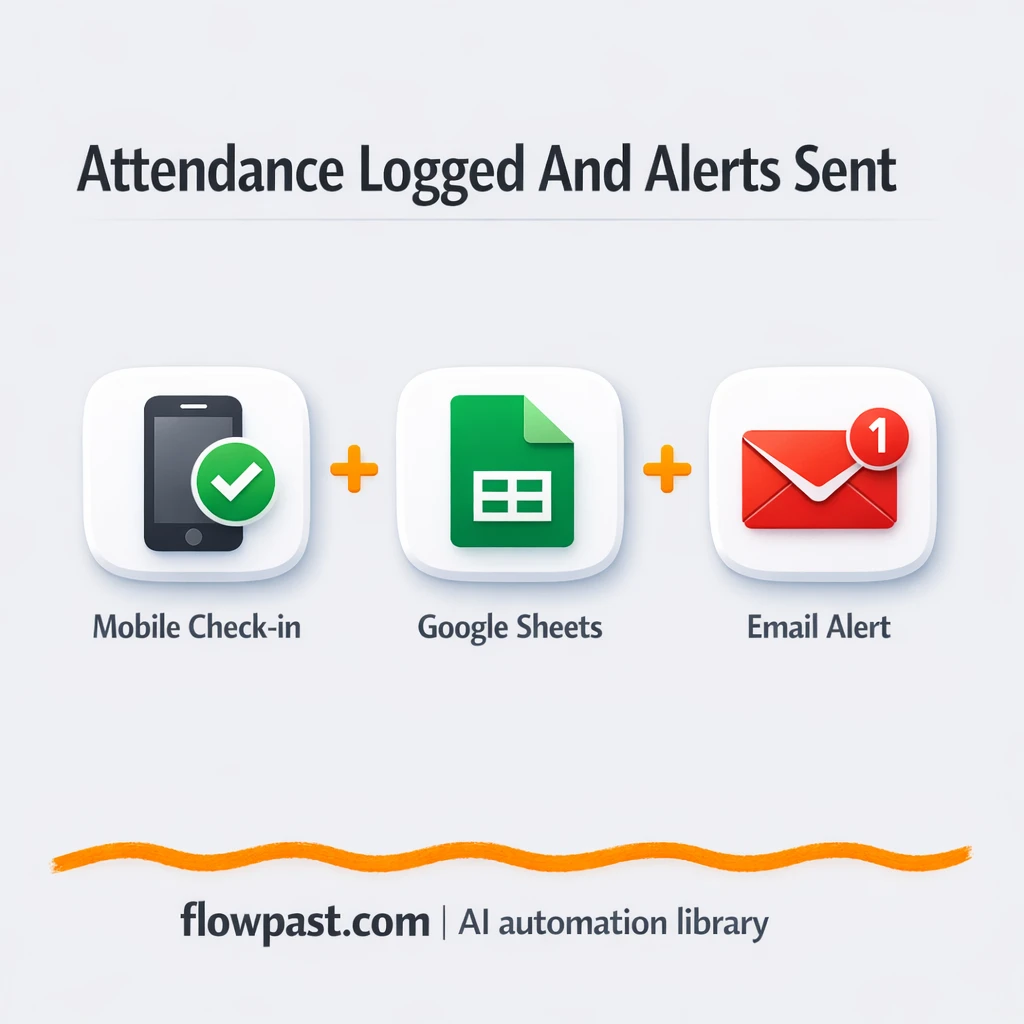
You’ll see how the workflow captures a check-in via webhook, formats it, appends it to Google Sheets, and sends a Gmail-style email alert so nothing slips through.
How This Automation Works
Here’s the complete workflow you’ll be setting up:
n8n Workflow Template: Google Sheets + Gmail: student check-ins logged fast
flowchart LR

    subgraph sg0["Flow 1"]
        direction LR
        n0["<div style='background:#f5f5f5;padding:10px;border-radius:8px;display:inline-block;border:1px solid #e0e0e0'><img src='https://flowpast.com/wp-content/uploads/n8n-workflow-icons/webhook.dark.svg' width='40' height='40' /></div><br/>Student Check-in"]
        n1@{ icon: "mdi:swap-vertical", form: "rounded", label: "Format Data", pos: "b", h: 48 }
        n2@{ icon: "mdi:message-outline", form: "rounded", label: "Email Teacher", pos: "b", h: 48 }
        n3["<div style='background:#f5f5f5;padding:10px;border-radius:8px;display:inline-block;border:1px solid #e0e0e0'><img src='https://flowpast.com/wp-content/uploads/n8n-workflow-icons/webhook.dark.svg' width='40' height='40' /></div><br/>Success Response"]
        n4@{ icon: "mdi:database", form: "rounded", label: "Append or update row in sheet", pos: "b", h: 48 }
        n1 --> n4
        n2 --> n3
        n0 --> n1
        n4 --> n2
    end

    %% Styling
    classDef trigger fill:#e8f5e9,stroke:#388e3c,stroke-width:2px
    classDef ai fill:#e3f2fd,stroke:#1976d2,stroke-width:2px
    classDef aiModel fill:#e8eaf6,stroke:#3f51b5,stroke-width:2px
    classDef decision fill:#fff8e1,stroke:#f9a825,stroke-width:2px
    classDef database fill:#fce4ec,stroke:#c2185b,stroke-width:2px
    classDef api fill:#fff3e0,stroke:#e65100,stroke-width:2px
    classDef code fill:#f3e5f5,stroke:#7b1fa2,stroke-width:2px
    classDef disabled stroke-dasharray: 5 5,opacity: 0.5
    class n4 database
    class n0,n3 api
    classDef customIcon fill:none,stroke:none
    class n0,n3 customIcon
Why This Matters: Real-Time Check-ins Without Manual Logging
If student arrival data lives in someone’s head (or scattered across apps), the day starts with friction. A student checks in at the door, someone screenshots it, another person pastes it into a spreadsheet later, and by then the “real-time” part is gone. The worst part is the mental load. You’re not just recording attendance, you’re also answering follow-up questions, resolving mismatched spellings, and figuring out whether a check-in happened at all. One mistake can turn into a parent call or a compliance headache.
It adds up fast. Here’s where the process usually breaks down.
- Someone has to retype each check-in, and that usually means about 1–2 minutes per student during the busiest part of the morning.
- Typos and inconsistent formats (names, IDs, classes) create “duplicate students” in your sheet that you clean up later.
- Teachers don’t get alerted in the moment, so they’re interrupted later with “Did Alex arrive?” messages.
- Proof is fuzzy when you need it most, because timestamps aren’t consistent and logs don’t match.
What You’ll Build: Instant Student Check-in Logging + Teacher Email Alerts
This workflow turns a simple check-in event into a clean, trustworthy attendance record. It starts when a student checks in using a mobile app, QR scanner, or any system that can send a POST request to an n8n webhook. The workflow immediately maps the incoming JSON (like student name, student ID, and class) into a consistent format, adds the current date and time, and writes it into Google Sheets. Right after the row is stored, it emails the class teacher with a formatted “check-in received” notification. Finally, it returns a success response to the original app so the student (or staff member scanning) gets instant confirmation.
The workflow begins with a public webhook, then cleans the data so the spreadsheet stays tidy. Google Sheets becomes the single source of truth, and the email alert keeps staff in the loop without extra messages or manual follow-ups.
What You’re Building
| What Gets Automated | What You’ll Achieve |
|---|---|
|
|
Expected Results
Say a grade level has about 30 students checking in each morning. If someone manually logs each one at roughly 2 minutes per check-in (open the sheet, type the name, add class, add time), that’s about 1 hour of clerical work before the day even starts. With this workflow, the check-in is captured instantly, the sheet updates automatically, and the email goes out right away. Your “work” becomes checking the sheet when needed, which is basically a few seconds.
Before You Start
- n8n instance (try n8n Cloud free)
- Self-hosting option if you prefer (Hostinger works well)
- Google Sheets for your central attendance log.
- Email (SMTP / Gmail-like sending) to notify the teacher instantly.
- Webhook-capable check-in app (QR scanner or mobile app) to send student data.
Skill level: Beginner. You’ll paste in a webhook URL, connect Google Sheets, and set an email recipient.
Want someone to build this for you? Talk to an automation expert (free 15-minute consultation).
Step by Step
A student check-in hits your webhook. A QR scanner or mobile app sends a POST request containing fields like student_name, student_id, and class_name to n8n’s public webhook URL.
The workflow standardizes the data. A mapping step cleans the incoming JSON so your spreadsheet rows are consistent, and it adds the current date and time automatically. This is the part that prevents messy logs later.
Google Sheets gets updated immediately. The workflow appends (or updates) a row in your attendance sheet using the mapped fields, so the log stays current without anyone opening the file.
The teacher gets an email alert, then the app gets a “success.” n8n sends a formatted email to the teacher (or a shared inbox), then returns a confirmation response so your check-in app can show “Checked in.” Clean, simple, reliable.
You can easily modify the email recipient logic to route by class, or change the sheet structure to match your existing attendance format. See the full implementation guide below for customization options.
Step-by-Step Implementation Guide
Step 1: Configure the Webhook Trigger
Set up the incoming webhook so external check-in data can enter the workflow and pass into the mapping step.
- Add the Incoming Attendance Webhook node as your trigger.
- Set the HTTP Method to
POST. - Set the Path to
student-checkin. - Set the Response Mode to
responseNodeso the reply is handled by Return Success Reply. - Connect Incoming Attendance Webhook to Map Check-in Fields to match the execution flow.
Step 2: Connect Google Sheets
Configure the spreadsheet destination that stores the attendance record.
- Add the Update Spreadsheet Row node after Map Check-in Fields.
- Credential Required: Connect your googleApi credentials.
- Set Authentication to
serviceAccount. - Set Operation to
appendOrUpdate. - Set Document ID to
[YOUR_ID]and Sheet Name to[YOUR_ID].
Step 3: Set Up Map Check-in Fields
Map the incoming webhook payload into normalized fields for the sheet and downstream notifications.
- Add the Map Check-in Fields node between Incoming Attendance Webhook and Update Spreadsheet Row.
- Set student_name to
{{ $json.body.student_name }}. - Set student_id to
{{ $json.body.student_id }}. - Set class_name to
{{ $json.body.class_name }}. - Set date to
{{ $now.format('yyyy-MM-dd') }}and time to{{ $now.format('HH:mm') }}. - Set status to
present.
Step 4: Configure Output/Action Nodes
Send the instructor notification and return a JSON response to the webhook caller.
- Add the Dispatch Instructor Email node after Update Spreadsheet Row.
- Credential Required: Connect your smtp credentials.
- Set To Email to
[YOUR_EMAIL]and From Email to[YOUR_EMAIL]. - Set Subject to
Student Check-in Alertand Text toPlease check attendance sheet. - Add the Return Success Reply node after Dispatch Instructor Email.
- Set Respond With to
json. - Set Response Body to
{
"success": true,
"message": "{{ $('Map Check-in Fields').item.json.student_name }} checked in successfully",
"time": "{{ $('Map Check-in Fields').item.json.time }}"
}
.
student_name or time, verify that Map Check-in Fields runs before Return Success Reply and that the incoming payload includes body.student_name.Step 5: Test and Activate Your Workflow
Validate that the webhook receives data, the sheet updates, and the email and response are sent.
- Click Execute Workflow and send a test POST request to the Incoming Attendance Webhook URL with a JSON body containing
student_name,student_id, andclass_name. - Confirm a new row is created or updated in the target sheet via Update Spreadsheet Row.
- Check that Dispatch Instructor Email sends the notification to
[YOUR_EMAIL]. - Verify the webhook response JSON contains the student name and time from Map Check-in Fields.
- Toggle the workflow to Active for production use.
Troubleshooting Tips
- Google Sheets access can fail if the connected Google account loses permission to the spreadsheet. If it breaks, check the sheet’s Share settings and the credential in n8n first.
- If your webhook is called from a school network or a locked-down mobile device, the request may never reach n8n. Test the webhook URL from a normal browser or Postman to confirm it’s publicly reachable.
- Email sending often fails for boring reasons: wrong SMTP port, “less secure app” restrictions, or a missing From address. Verify your SMTP settings in the “Send Email” node before changing the rest of the workflow.
Quick Answers
About 30 minutes if your Sheet and email sending are ready.
No. You’ll connect Google Sheets, set the teacher email, and paste in the webhook URL.
Yes. n8n has a free self-hosted option and a free trial on n8n Cloud. Cloud plans start at $20/month for higher volume. You’ll also need to factor in email sending costs if you use a paid SMTP provider (often low, sometimes included with your account).
Two options: n8n Cloud (managed, easiest setup) or self-hosting on a VPS. For self-hosting, Hostinger VPS is affordable and handles n8n well. Self-hosting gives you unlimited executions but requires basic server management.
Yes, and it’s honestly the best part. You can route emails by class by adding a simple If step before “Dispatch Instructor Email,” or swap the single recipient for a lookup table stored in Google Sheets. You can also change “Update Spreadsheet Row” to write to different tabs per grade, or add extra columns like “Check-in method” (QR vs. staff). If your check-in app sends different field names, you only need to adjust the “Map Check-in Fields” mapping once.
Usually it’s permissions or an expired Google authorization. Reconnect your Google Sheets credential in n8n, then confirm the spreadsheet is shared with that same Google account. Also check that the Sheet ID and range match the exact tab you’re writing to, because a renamed tab can quietly break writes.
For most schools, it’s plenty: a webhook-triggered workflow like this can handle steady check-ins all morning as long as your n8n instance is running.
Often, yes, because you can keep the logic in one place and host it yourself. n8n is also more flexible when you need branching (like routing by class), custom responses back to the check-in app, or tighter control over how data is transformed before it hits Google Sheets. Zapier and Make can do it too, but webhook handling and multi-step logic can get expensive or awkward as you add rules. If you want the simplest possible hosted experience and only have one class, those tools may be fine. Talk to an automation expert if you want help choosing.
Once this is running, check-ins become boring in the best way. Your sheet stays clean, teachers stay informed, and you stop spending the first hour of the day doing data entry.
Need Help Setting This Up?
Our automation experts can build and customize this workflow for your specific needs. Free 15-minute consultation—no commitment required.
